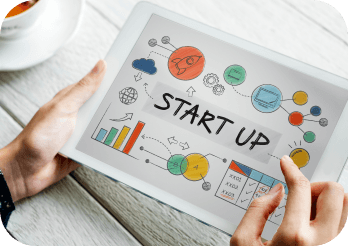
The Anatomy of a Startup
Understand what defines a startup and the key traits that set it apart from traditional businesses.
What is a Startup?
Before we even begin, it’s important to note that every startup is a business, but not every new business is a startup.
Think of it like this: A new tea stall opens at the corner of your street. That’s a business. But when someone builds an app that lets you order chai from any corner of your city in under 10 minutes using AI-powered delivery predictions, that’s a startup.
Now, coming back to where we started. What is a startup?
In simple terms, a startup is a young company created to develop and bring to market an innovative product, service, or business model to solve a specific problem in a new or better way.
However, a startup is not defined by its age alone. It’s also defined by other factors like its ambition and approach.
Key Traits of Startups
Startups are defined by several key traits:
-
Innovation: Offers something new, improved, or disruptive compared to existing solutions.
-
Scalability: Builds on a business model that can grow significantly without proportional increases in resources.
-
Rapid Growth: Faces uncertainty in market demand, competition, and funding, but can achieve substantial returns when successful.
-
Funding Needs: Seeks external investment (e.g., venture capital, angel investors) to fuel growth.
-
Lean and Agile: Operates with small teams, fast decision-making, and the ability to pivot based on feedback.
Let’s zoom in on each trait.
1. Innovation
At the heart of every successful startup lies innovation, but it doesn’t always mean cutting-edge technology. It can be anything that helps you stand out. Sometimes it can be a clever tweak to a process, pricing strategy, or customer experience that makes all the difference. Thus, innovation can be in terms of:
- New solutions to old problems (e.g., Uber redefining urban transport).
- Improved approaches that outperform existing alternatives (e.g., Canva simplifying graphic design for non-designers).
- Disruptive business models that reshape entire industries (e.g., Airbnb challenging traditional hotels).
2. Scalability
Scalability is the ability to serve 10x more customers without needing 10x more resources. This trait attracts investors because it suggests that once the model works, it can expand exponentially with limited incremental cost. For scalability, startups often rely on technology or network effects.
For example:
- A software platform can onboard thousands of new users without dramatically increasing staffing.
- A marketplace like Amazon becomes more valuable as more buyers and sellers join, creating a self-reinforcing growth loop.
3. Rapid Growth
Startups operate in fast-moving, competitive environments where the window of opportunity can be small. They face uncertainty in:
- Market demand (will customers adopt the solution?)
- Competition (can rivals replicate or improve upon the model?)
- Funding (can they secure enough capital to sustain momentum?)
Yet, when they succeed, the returns can be substantial not just for founders, but for investors and early employees as well. Rapid growth is both a goal and a necessity. In many cases, if you’re not growing quickly, you’re losing ground.
4. Funding Needs
Unlike many small businesses that rely on self-funding or bank loans, startups often require significant external investment early on. This funding fuels:
- Product development
- Market entry and customer acquisition
- Hiring specialized talent
Some of the common sources for funding include:
- Angel investors who bet on early-stage ideas
- Venture capital firms that fund scalable business models
- Corporate investors seeking strategic partnerships
5. Lean and Agile
Startups typically begin with small, highly committed teams where each member wears multiple hats. This lean structure enables:
- Rapid decision-making without bureaucratic delays
- Quick pivots when market feedback suggests a change in direction
- Experimentation to find the most effective product-market fit
The agility of startups allows them to seize opportunities faster than large corporations, as they are often weighed down by layers of approval and legacy systems.
Types of Startups
India’s startup ecosystem is a melting pot of ideas, ambitions, and innovations. According to DPIIT, India has emerged as the third-largest startup ecosystem in the world, with more than 100,000 startups recognized as of 2024.
But not all startups are built the same way. They differ in purpose, scale, funding needs, and growth trajectory. So, understanding the types helps aspiring entrepreneurs choose the right approach and strategy.
Here’s a detailed look at the six major categories of startups:
1. Lifestyle Startups
The roots of lifestyle startups lie primarily in the founder’s hobbies or interests. This type of startup aims to support the personal goals, passions, or preferred way of life of the founder(s). Profit is important, but it’s often secondary to maintaining a certain idea of work-life balance and creative freedom. These startups typically don’t aim for hypergrowth or large-scale market domination.
Key Traits of Lifestyle Startups are:
- Founded around a personal interest, hobby, or skill.
- Growth is often intentional and steady, not aggressive.
- The business model is sustainable with a modest market size.
- Often bootstrapped (self-funded) instead of raising big external investment.
2. Small Business Startups
Small business startups are created to serve a local or niche market. They usually thrive on community trust and relationships with a physical presence. However, small business startups can have an online presence through a website or an app, but their business isn’t exactly based on tech. They often employ local teams and rely on stable, loyal customer bases. Another important point to note is that they might not grow exponentially, but they can have consistent profits for years.
Key Traits of Small Business Startups are:
- Mostly operate in a single city or a limited geography.
- Moderate to low scalability; expansion is optional, not the main goal.
- Stable revenue models based on repeat customers.
- Typically self-funded or financed through small business loans.
3. Scalable Startups
This is a high-risk, high-reward category. Scalable startups are the classic “Silicon Valley-style” startups, as they are designed from day one to grow rapidly. They face fierce competition and are under constant pressure to innovate in order to dominate large markets and often disrupt traditional industries. Scalability means adding more customers without proportionally increasing costs.
Key Traits of Scalable Startups are:
- Target massive markets (national or global).
- Heavy use of technology to enable growth.
- Often backed by venture capital or angel investors.
- Have an aggressive growth strategy from the start.
4. Buyable Startups
The primary intent of buyable startups is to be acquired by a larger company for strategic, technological, or market reasons. Founders aim to build something unique, valuable, and attractive enough to catch the eye of industry giants. Buyable startups typically appeal to serial entrepreneurs who enjoy building, selling, and moving on to the next big idea. The exit strategy is integrated into the business model from day one.
Key Traits of Buyable Startups are:
- Shorter lifecycle compared to other startup types.
- Focused on niche technology, innovation, or market segment.
- Often require seed or early-stage funding, but not necessarily large rounds.
- Valued more for strategic fit than standalone profitability.
5. Social Startups
Social startups are appealing to founders with a strong sense of purpose. They are driven by a mission to solve pressing social, environmental, or community problems. By combining purpose with business models, founders try to create a measurable, long-term positive impact while also being financially sustainable.
Key Traits of Social Startups are:
- Mission-driven rather than purely profit-driven.
- Preferred areas of work include education, healthcare, renewable energy, and social inclusion.
- The source of funding is mainly impact investors, grants, or CSR partnerships.
- Success is measured by social metrics alongside financial ones.
6. Large Company Startups
These are startup-like initiatives inside large corporations focused on creating and promoting new products, services, or business models. They operate with the agility and innovation culture of a startup but have the backing and resources of an established enterprise. Thus, large company startups can scale faster than traditional startups.
Key Traits of Large Company Startups are:
- Protected funding and access to company infrastructure.
- Faster market access due to existing brand recognition.
- Freedom to experiment with new technologies or markets.
- Risk tolerance for high-impact innovation.
Understanding the Startup Ecosystem
A startup doesn’t grow in isolation. It thrives within an interconnected web of people, organizations, and institutions, each playing a distinct but complementary role. Startups depend on a variety of stakeholders to provide resources, knowledge, and opportunities for growth.
In a strong ecosystem, ideas are nurtured, funding is accessible, mentorship is abundant, and the legal and economic climate supports innovation. In a weak ecosystem, even the most promising ideas may wither before they bloom.
Key Players in the Startup Ecosystem
1. Founders
Founders are the heart and soul of any startup. They are the visionaries capable of imagining bold possibilities while executing practical steps to get there. Without them, the startup ecosystem lacks the spark to ignite innovation. It is the founders who:
- Spot opportunities in the form of unmet needs or market gaps.
- Assemble teams to turn ideas into tangible products or services.
- Shoulder the risk of failure while inspiring others to believe in the mission.
2. Investors
Startups often need more capital than their founders can personally provide. Investors step in to fill that gap, offering funding in exchange for equity or future returns. Beyond money, investors often provide connections, credibility, and strategic guidance.
This group includes:
- Venture Capitalists (VCs): They are professional firms that manage large funds to back high-growth startups.
- Angel Investors: These are people with high net worth who invest personal funds, often at earlier stages.
- Corporate investors: These are established companies investing strategically in startups aligned with their goals.
3. Incubators – The Early-Stage Nurturers
Incubators are early-stage startup nurturers as they help founders refine their idea before seeking larger investments. They provide:
- Physical workspaces at reduced or no cost.
- Access to basic resources (internet, meeting rooms, legal help).
- Guidance from experienced entrepreneurs.
- Opportunities to network with other founders.
4. Accelerators
While incubators nurture, accelerators fast-track growth. Accelerators work best for startups that already have an MVP and some traction, but need a boost to reach the next level. Accelerator programs typically run for a few months and provide:
- Seed funding in exchange for equity.
- Intensive mentorship from industry experts.
- A structured curriculum to sharpen business models.
- Support for Demo Days, where startups pitch to a room full of potential investors.
5. Mentors
Mentors are experienced professionals who act as a guiding light for founders. Their value lies not only in what they know, but in who they know and how they can open doors that might otherwise remain closed. They are often ex-founders, industry veterans, or domain experts who:
- Provide honest feedback on business strategy.
- Connect startups with potential partners and customers.
- Offer moral support during the inevitable ups and downs of entrepreneurship.
6. Government Bodies
Government agencies play a critical role in shaping the entrepreneurial landscape. In countries like India, initiatives such as Startup India and Atal Innovation Mission have strengthened the startup ecosystem by encouraging both domestic and global entrepreneurship through:
- Startup-friendly policies (simplified regulations, tax benefits).
- Funding programs and grants.
- Innovation clusters and tech parks.
- Intellectual property (IP) protection to safeguard innovations.
The Lifecycle of a Startup
A startup’s journey is rarely a straight path. It’s a winding road with unexpected turns, detours, and occasional U-turns. While no two journeys are identical, most startups pass through six broad stages. Understanding these stages helps both founders and investors anticipate challenges, allocate resources wisely, and make informed decisions at every step.
Let’s take a look.
1. Ideation
In the ideation stage, founders identify a problem that is worth solving and affects enough people to justify building a business around it. An idea may come from personal frustrations, industry gaps, or emerging market trends.
During the ideation stage, focus is on:
- Thoroughly understanding the pain points.
- Brainstorming potential solutions.
- Assessing the feasibility of the idea.
Many great startups begin not with a product idea, but with a problem-centric focus. As they move forward in their journey, they refine the solution over time.
2. Validation
Validation helps startups ensure that their idea holds water and they’re not building in a vacuum. The goal here is simple: minimize risk before committing significant time and money. Many ideas are given up or drastically reshaped during this phase. A failed validation saves founders from a much bigger failure later.
The key activities during this stage include:
- Creating Minimum Viable Products (MVPs).
- Conducting market research.
- Testing assumptions about the market and product.
- Creating customer personas to understand target users.
- Running pilot tests, landing pages, and surveys to measure interest.
- Gathering early user feedback to determine if the idea is worth pursuing.
3. Early Growth
If validation yields positive results, it’s time to start scaling. This is when startups:
- Build a functional product beyond the MVP.
- Hire key team members to strengthen operations.
- Begin consistent marketing and customer acquisition.
- Seek seed funding or Series A investment to fuel growth.
To seal the seed funding deal, traction is the key. Investors want proof that your product is gaining real-world adoption. This can be depicted through user growth, revenue, or even strong engagement metrics.
4. Expansion
Once the foundation is stable, startups shift focus to market expansion. This could mean:
- Entering new geographic regions.
- Launching complementary products or services.
- Forming strategic partnerships to boost reach.
While expansion seems exciting, it demands careful balancing. Growing too fast can strain resources, and growing too slowly risks losing market share to competitors. Thus, strong leadership, robust systems, and adequate funding become non-negotiable for successful expansion.
5. Maturity
At maturity, the startup transitions into a more established business and strives to sustain success. By this stage, revenue streams are predictable, customer loyalty is strong, and operations are more optimized. So the focus shifts from pure growth to maximizing profitability, streamlining internal processes, retaining top talent, and strengthening the brand’s market position.
Even though the urgency of survival decreases, the risk of complacency increases. Threats such as market disruptions, new competitors, or shifts in customer preferences still exist. Therefore, to maintain their competitive edge, mature startups should always keep on innovating and improving.
6. Exit
An “exit” marks the point where founders and investors begin to realize returns on their years of effort and capital. Common exit strategies include:
- Initial Public Offering (IPO): Listing shares on a public stock exchange to raise large-scale funding and allow early investors to cash out.
- Acquisition: Being purchased by a larger company, often for strategic synergies.
- Merger: Combining with another company to consolidate resources and market presence.
It’s important to note that exits don’t always mean the end. Many founders go on to start new ventures and become serial entrepreneurs. For investors, a successful exit validates their decision to back the startup early on and also lays the foundation for more successful partnerships in the future.